Flow Meters for Jet Fuel Applications: Selection, Accuracy, and Best Practices
Jet fuel measurement plays a critical role in aviation operations, from commercial aircraft refueling and fuel distribution terminals to aerospace manufacturing and engine testing facilities. Even small measurement errors can lead to inventory discrepancies, increased operating costs, and fueling inefficiencies. Because of this, selecting the right flow meter technology is essential for maintaining accuracy, reliability, and operational efficiency.
Jet fuels such as Jet A, Jet A-1, JP-5, and JP-8 are refined petroleum products with relatively low viscosity and specific handling requirements. These fuels are commonly transferred at high flow rates and often under demanding operating conditions. The flow meter chosen for these applications must provide repeatable measurements while minimizing pressure loss and maintaining performance over long periods of operation.
Why Accurate Jet Fuel Measurement Matters
The aviation industry depends on precise fuel measurement for both operational and financial reasons. Every gallon of fuel delivered to an aircraft or transferred between storage systems must be accurately accounted for. In commercial airports, fuel providers use flow measurement data to manage inventory and billing. In aerospace testing environments, engineers rely on accurate flow data to validate engine performance and verify fuel system operation.
Inaccurate measurements can create several challenges, including:
- Fuel inventory discrepancies
- Increased operating expenses
- Inefficient fueling operations
- Difficulties during system audits and inspections
Accurate flow measurement also helps operators optimize fuel management programs and monitor system performance over time. Reliable flow data provides valuable insight into system efficiency, identifies abnormal operating conditions, and supports preventive maintenance initiatives.
Common Jet Fuel Applications Requiring Flow Measurement
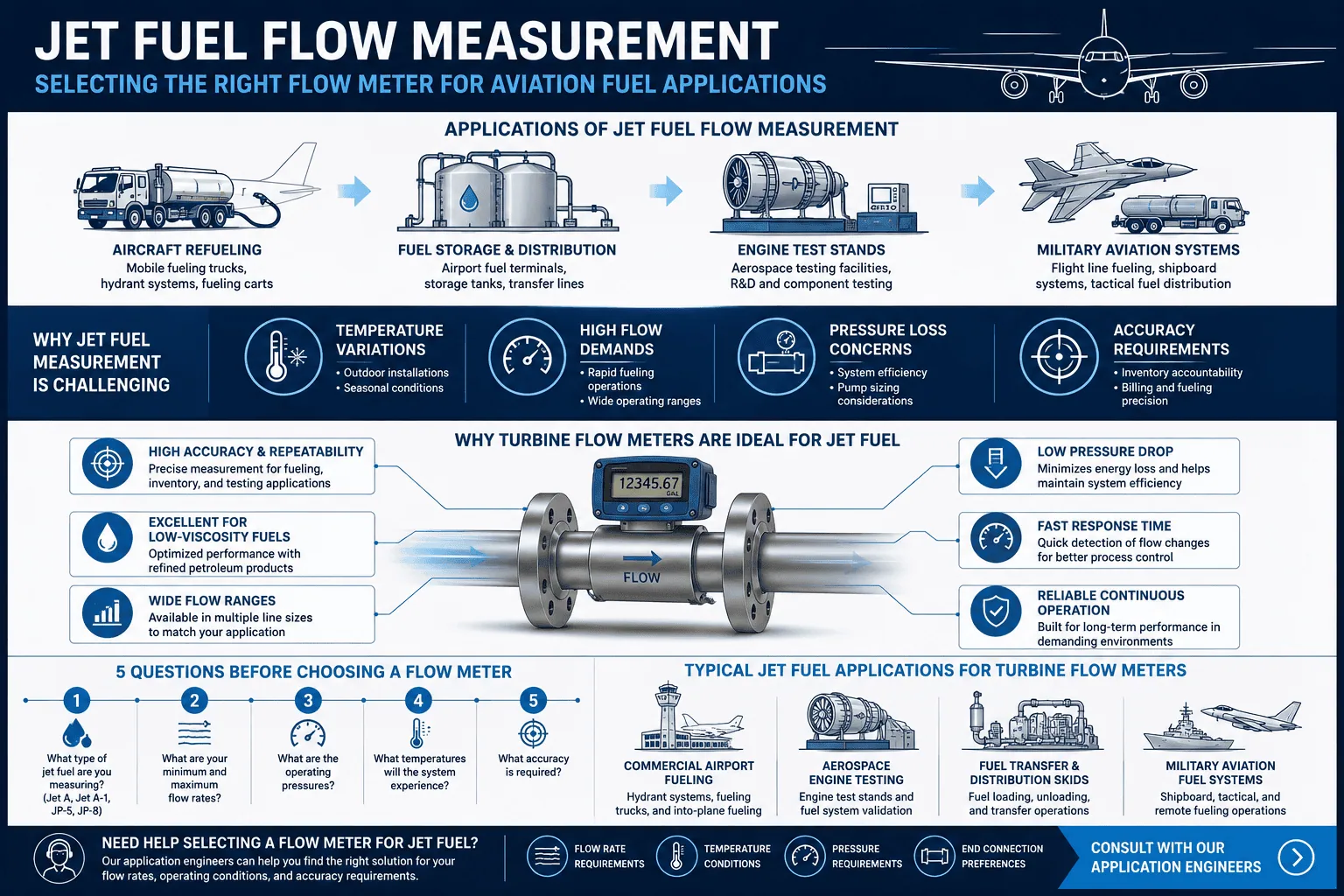
Jet fuel flow measurement is used throughout the aviation supply chain. One of the most visible applications is aircraft refueling. Mobile fueling trucks, hydrant carts, and airport fueling stations all rely on flow meters to accurately dispense fuel to aircraft.
Flow meters are also widely used in airport fuel distribution systems. These systems transfer fuel from storage tanks to distribution pipelines, fueling vehicles, and loading facilities. Because large volumes of fuel move through these systems daily, measurement accuracy is critical for inventory control and operational efficiency.
The aerospace industry presents another important application. Engine manufacturers and aircraft component suppliers use flow meters in fuel system test stands and research facilities. Engineers often need highly repeatable flow measurements to evaluate fuel system performance and validate testing procedures.
Military aviation operations also depend heavily on accurate fuel measurement. Shipboard fueling systems, tactical fuel distribution equipment, and military flight line operations require rugged instrumentation capable of performing reliably in demanding environments.
Challenges of Measuring Jet Fuel
Although jet fuel is generally considered an ideal fluid for turbine flow measurement, several operating challenges still exist.
Flow rates can vary significantly between applications. A test stand may require relatively low flow rates for component testing, while airport fueling operations often involve substantially higher flow demands. The selected meter must perform accurately across its expected operating range.
Temperature variations can also affect system performance. Fuel may be stored outdoors and subjected to seasonal temperature swings. Certain applications may experience elevated temperatures due to environmental conditions or equipment operation.
Pressure requirements are another important consideration. Operators generally seek to minimize pressure loss within fuel systems to improve efficiency and maintain adequate flow conditions. Excessive pressure drop can increase pumping requirements and reduce overall system performance.
Finally, jet fuel systems often require continuous operation with minimal downtime. The selected flow meter should be durable, dependable, and capable of maintaining accuracy under demanding operating conditions.
Why Turbine Flow Meters Are Well-Suited for Jet Fuel
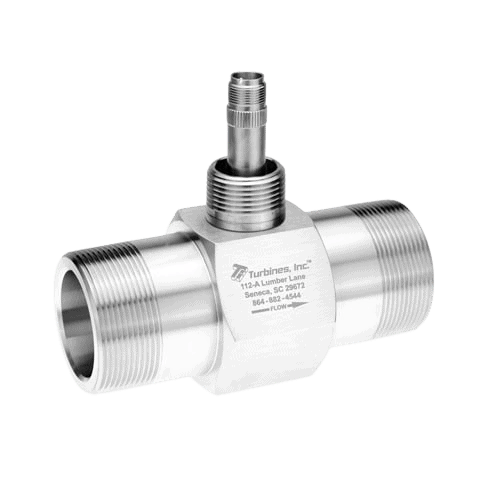
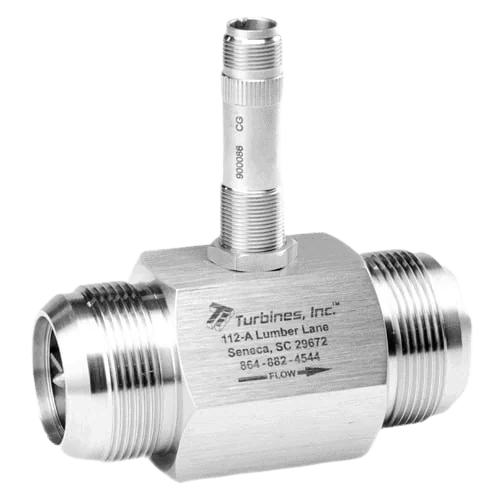
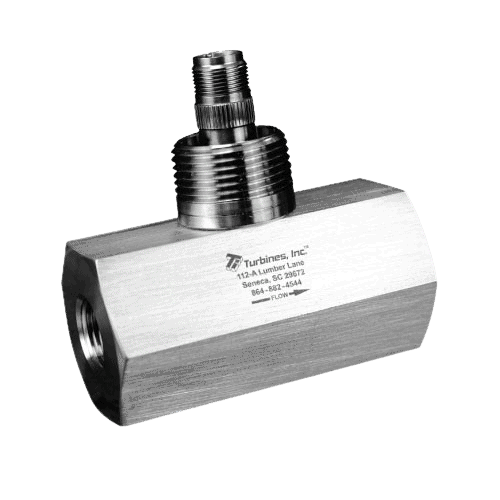
Turbine flow meters have long been used in aviation fueling applications because they are particularly well-suited for measuring low-viscosity refined petroleum products.
As fluid moves through the meter, it rotates a precision turbine rotor at a speed proportional to the volumetric flow rate. Electronic pickup coils detect rotor movement and generate an output signal that can be displayed, monitored, or transmitted to control systems.
Several characteristics make turbine flow meters an excellent choice for jet fuel applications.
High Accuracy and Repeatability
Many aviation applications require highly repeatable measurements. Turbine flow meters are capable of delivering excellent accuracy and repeatability, making them suitable for fueling operations, inventory management, and testing applications.
Excellent Performance with Low-Viscosity Fuels
Jet fuel possesses flow characteristics that align well with turbine meter operation. Low-viscosity liquids typically allow turbine flow meters to achieve excellent linearity and response characteristics over a wide operating range.
Wide Flow Ranges
Aviation fueling systems can vary considerably in size and operating requirements. Turbine flow meters are available in numerous line sizes and flow capacities, allowing engineers to select a meter that matches application requirements.
Low Pressure Loss
Minimizing pressure drop is often a priority in fuel transfer systems. Turbine flow meters generally produce relatively low pressure losses when properly sized, helping maintain efficient system performance.
Durability and Reliability
Jet fuel systems often operate continuously and may be installed in demanding environments. Turbine flow meters are designed to withstand long operating periods while maintaining measurement performance and reliability.
Key Considerations When Selecting a Jet Fuel Flow Meter
Several factors should be evaluated when selecting a flow meter for jet fuel service.
Engineers should first establish the expected minimum and maximum flow rates. The meter should operate efficiently throughout its normal flow range without sacrificing measurement accuracy.
Pressure and temperature requirements should also be carefully reviewed. Understanding system operating conditions helps ensure the selected meter can safely perform under all expected scenarios.
Material compatibility is equally important. Wetted materials and seals should be suitable for long-term exposure to jet fuel and any additives that may be present.
Installation requirements should also be considered early in the selection process. Available straight pipe lengths, filtration requirements, and connection styles all influence flow meter performance and ease of installation.
Selecting the Right Flow Meter for Your Application
Every jet fuel application presents unique operating conditions and performance requirements. A flow meter that performs exceptionally well in an airport fueling system may not be the ideal solution for an aerospace test stand or military fuel distribution system.
Understanding the fuel type, operating flow range, pressure conditions, temperature requirements, and accuracy expectations is essential when selecting a meter. For many aviation applications, turbine flow meters offer an excellent combination of accuracy, repeatability, low pressure loss, and long-term reliability.
Whether measuring fuel for commercial aircraft refueling, aerospace testing, or fuel transfer operations, selecting the proper flow meter can improve operational efficiency, reduce measurement uncertainty, and provide the dependable performance required throughout the aviation industry.