Cooling and flushing water systems are among the most critical utility systems found in industrial facilities. While these systems often operate in the background, their performance directly impacts equipment reliability, production efficiency, maintenance costs, and overall plant uptime. Whether cooling a heat exchanger, protecting a compressor, flushing process piping during maintenance, or circulating water through a data center cooling loop, maintaining the correct flow rate is essential.
Without accurate flow measurement, operators may have little visibility into system performance until problems begin to develop. Reduced flow can result in overheating, inefficient heat transfer, excessive energy consumption, or even catastrophic equipment failures. Excessive flow can be equally problematic, leading to unnecessary water consumption, higher pumping costs, and increased wear on system components.
Cooling and flushing water applications are common across a wide range of industries, including manufacturing, power generation, chemical processing, data centers, and oil and gas facilities. In each of these environments, engineers depend on reliable flow measurement technology to ensure that water systems are performing as designed.
Among the many flow measurement technologies available today, turbine flow meters continue to be a preferred solution for clean water applications. Their combination of high accuracy, excellent repeatability, low maintenance requirements, and cost-effective performance makes them an ideal choice for many cooling and flushing water systems.
Understanding Cooling and Flushing Water Systems
What Is Cooling Water?
Cooling water is used to remove heat from equipment, processes, and mechanical systems. As industrial equipment operates, it generates heat that must be removed to maintain safe operating temperatures and preserve equipment life. Cooling water absorbs this heat and transfers it away from the process, often through a heat exchanger, cooling tower, chiller, or other heat rejection system.
Cooling water systems generally fall into two categories: open-loop and closed-loop systems. Open-loop systems continuously introduce fresh water into the process and discharge or recycle it after use. Closed-loop systems continuously recirculate the same water or coolant through the system while removing heat through dedicated cooling equipment.
Both types of systems require accurate flow measurement. Engineers need to verify that adequate cooling water is reaching critical assets while monitoring overall system efficiency. In large facilities, cooling water may be distributed across dozens or even hundreds of pieces of equipment, making flow monitoring an important part of preventive maintenance and operational reliability programs.
What Is Flushing Water?
Flushing water is used during startup, maintenance, commissioning, and cleaning operations. The purpose of flushing is to remove contaminants, debris, scale, residual chemicals, welding slag, or other materials that may be present in piping systems and process equipment.
Proper flushing is critical because contaminants left behind can damage pumps, valves, flow meters, heat exchangers, and other sensitive equipment. During startup procedures, flushing also helps ensure that systems are clean and ready for operation.
Flow measurement plays an important role during flushing activities because achieving the proper flushing velocity is often necessary to effectively remove contaminants. Engineers and maintenance personnel frequently rely on flow data to verify that cleaning procedures have been completed successfully and documented properly.
Why Accurate Flow Measurement Matters
Preventing Equipment Damage
The primary purpose of many cooling water systems is equipment protection. When cooling water flow falls below required levels, heat can build rapidly within machinery and process equipment.
In heat exchangers, inadequate flow reduces heat transfer efficiency and can cause operating temperatures to rise above design limits. Compressors, hydraulic systems, motors, and industrial engines often depend on cooling water to maintain safe operating conditions. Even a temporary loss of cooling flow can result in reduced equipment life, increased maintenance costs, or unexpected shutdowns.
Flow monitoring provides operators with immediate visibility into system performance. By identifying flow reductions early, facilities can address problems before they escalate into equipment failures or production interruptions.
Improving Process Efficiency
Accurate flow measurement is also essential for maximizing operational efficiency. Many cooling systems are designed around specific flow rates that deliver optimal thermal performance. When actual flow rates differ from design conditions, system efficiency often declines.
Flow data allows operators to evaluate cooling performance, optimize pump operation, and identify opportunities for reducing water and energy consumption. Because pumping systems can represent a significant portion of a facility’s energy usage, even modest improvements in efficiency can produce substantial long-term savings.
In addition, consistent flow measurement helps maintain stable process conditions. When cooling systems operate within their intended parameters, equipment performance becomes more predictable, product quality improves, and maintenance requirements often decrease.
Supporting Environmental Compliance
Water management has become an increasingly important objective for industrial facilities. Many organizations are working to reduce water consumption, improve sustainability metrics, and meet environmental reporting requirements.
Accurate flow measurement supports these initiatives by providing reliable data regarding water usage, consumption patterns, and discharge volumes. This information can be used to identify inefficiencies, support conservation programs, and demonstrate compliance with environmental regulations.
As sustainability goals become more prominent throughout industry, accurate flow measurement continues to play an important role in responsible water management strategies.
How Turbine Flow Meters Work
Basic Operating Principle
Turbine flow meters measure liquid flow using a precision rotor mounted within the flow stream. As water moves through the meter body, the rotor spins at a speed directly proportional to the velocity of the flowing liquid.
A magnetic pickup or electronic sensor detects the movement of the rotor blades and generates a series of electrical pulses. These pulses are converted into flow rate information by flow computers, displays, PLCs, or monitoring systems.
The relationship between pulses and volume is expressed through a calibration factor known as the K-factor. This value allows the flow meter to convert pulse output into accurate volumetric measurements.
Because turbine meters directly respond to fluid velocity, they provide highly repeatable measurements and rapid response to changing flow conditions.
Advantages of Turbine Technology
Several characteristics make turbine flow meters particularly well suited for cooling and flushing water applications. Their accuracy and repeatability allow operators to monitor system performance with confidence, while their fast response time makes them effective for detecting changing operating conditions.
Unlike some flow technologies that require complex electronics or extensive programming, turbine meters offer a straightforward and proven measurement solution. Their relatively simple operating principle has made them a trusted choice across industrial applications for decades.
Benefits of Turbine Flow Meters for Cooling and Flushing Water
High Accuracy at Moderate to High Flow Rates
Cooling water applications frequently operate within flow ranges where turbine flow meters perform exceptionally well. Properly sized turbine meters can achieve accuracy levels of ±0.5% of reading or better, making them suitable for both operational monitoring and process control applications.
This level of accuracy allows engineers to verify equipment performance, identify developing system issues, and optimize cooling operations with confidence.
Low Pressure Loss
Pressure loss is an important consideration in any water distribution system. Excessive pressure drop increases pump workload, raises energy consumption, and may negatively affect overall system performance.
Turbine flow meters are designed to minimize flow restriction while still providing accurate measurements. When correctly sized, they can deliver reliable performance without creating significant additional load on the pumping system.
Durable Construction
Many industrial turbine flow meters are manufactured from stainless steel and other corrosion-resistant materials designed for demanding operating environments.
Key durability benefits include:
- Long service life in industrial applications
- Excellent corrosion resistance
- Compatibility with a wide range of water qualities
- Reliable operation under varying pressure conditions
These characteristics help reduce maintenance requirements and contribute to lower total ownership costs over the life of the system.
Easy Integration with Control Systems
Modern industrial facilities increasingly rely on automated monitoring and control systems. Turbine flow meters integrate easily into these environments through a variety of output options.
Common integration features include pulse outputs, frequency signals, analog outputs, and digital communication capabilities. These outputs allow turbine meters to communicate with PLCs, SCADA systems, building management systems, and remote monitoring platforms.
The ability to provide real-time flow information improves visibility into system performance and supports data-driven operational decisions.
Key Installation Considerations
Straight Pipe Requirements
As a velocity-based flow measurement technology, turbine flow meters perform best when flow profiles are stable and predictable. Piping disturbances created by elbows, valves, pumps, reducers, and other components can introduce turbulence that affects measurement accuracy.
Providing adequate upstream and downstream straight pipe runs helps ensure the meter receives a uniform flow profile. Following manufacturer installation recommendations is one of the most effective ways to maximize performance and maintain stated accuracy.
Water Quality Considerations
Turbine flow meters perform best in clean liquid service. While they can tolerate normal water conditions, excessive debris, suspended solids, or particulate contamination may affect performance over time.
Where contamination is present, engineers often install strainers or filtration systems upstream of the meter. Proper filtration helps protect internal components and supports long-term measurement reliability.
Meter Sizing Best Practices
Correct meter sizing is one of the most important factors influencing flow meter performance. A meter should be selected based on actual operating conditions rather than simply matching pipe size.
Important sizing considerations include:
- Minimum operating flow rate
- Maximum operating flow rate
- System pressure
- Water temperature
- Future expansion requirements
A properly sized turbine meter will provide optimal accuracy, repeatability, and service life.
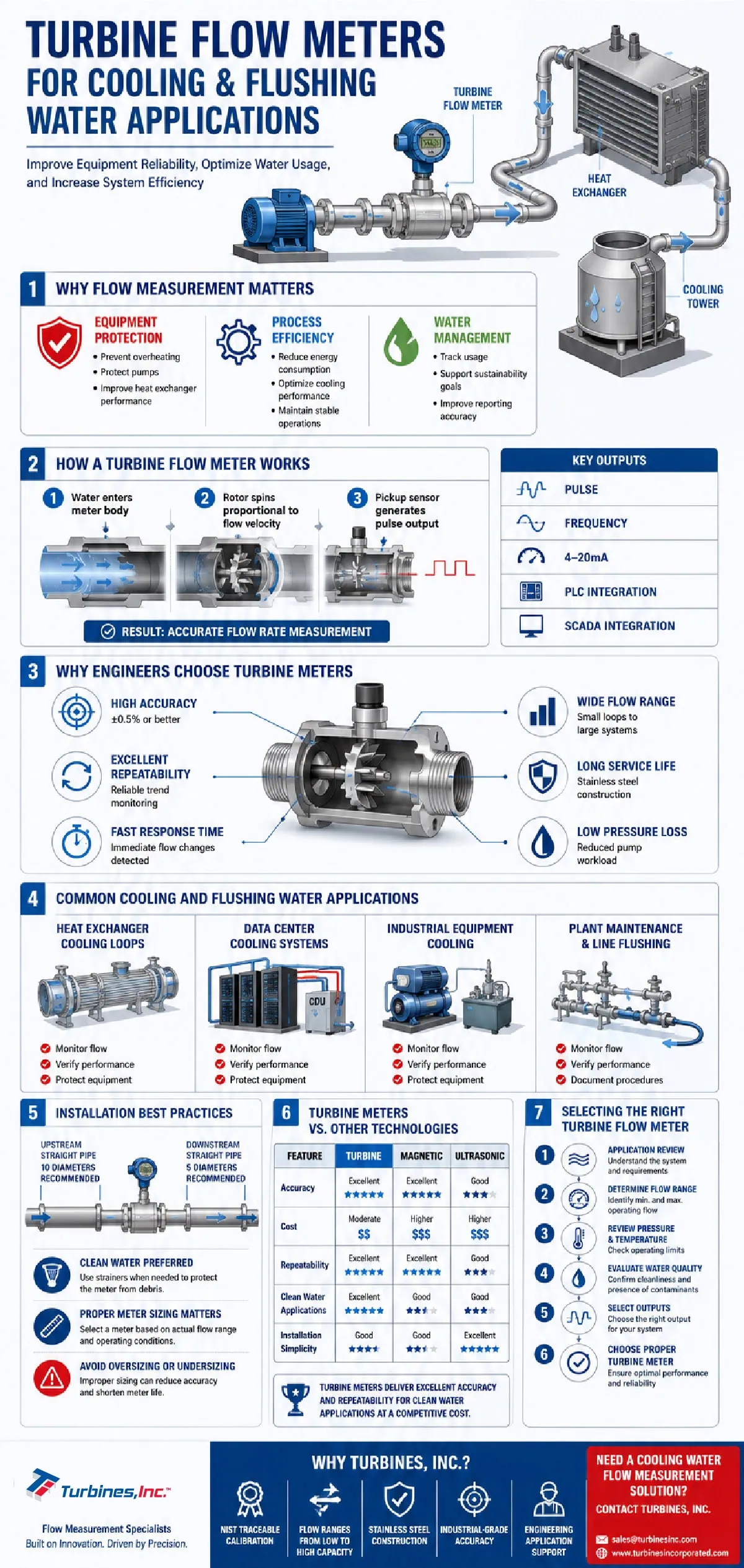
Common Cooling and Flushing Water Applications
Heat Exchanger Cooling Loops
Heat exchangers rely on adequate water flow or water glycol mixtures to remove thermal energy efficiently. Turbine flow meters provide operators with continuous visibility into cooling performance while helping protect valuable process equipment.
Data Center Cooling Systems
As liquid cooling adoption continues to increase within modern data centers, accurate flow measurement has become increasingly important. Cooling distribution units, direct-to-chip cooling systems, and facility water loops all depend on reliable flow monitoring to maintain proper thermal management.
Turbine flow meters provide the accuracy and repeatability necessary to ensure cooling systems operate as designed while supporting uptime requirements for mission-critical facilities.
Industrial Equipment Cooling
Industrial facilities use cooling water across a wide variety of equipment, including compressors, hydraulic systems, injection molding machines, turbines, generators, and process machinery. Reliable flow measurement helps maintain consistent cooling performance while protecting valuable assets.
Plant Maintenance and Line Flushing
During maintenance and commissioning activities, turbine flow meters help verify flushing velocities and document cleaning procedures. Accurate flow data supports quality assurance efforts and helps ensure systems are properly prepared for operation.
Turbine Meters vs. Other Water Flow Meter Technologies
Turbine vs. Electromagnetic Flow Meters
Electromagnetic flow meters offer excellent performance in conductive liquids and are widely used throughout industry. However, they are often more expensive than turbine meters and may not be necessary for many clean water applications.
For facilities seeking a balance of performance and cost-effectiveness, turbine meters frequently provide an attractive alternative.
Turbine vs. Ultrasonic Flow Meters
Ultrasonic flow meters offer non-invasive installation options and can be advantageous in certain applications. However, turbine meters often provide superior repeatability and can deliver highly reliable performance in clean liquid service.
When a Turbine Meter Is the Best Choice
Turbine flow meters are often the preferred solution when clean liquids are being measured, high accuracy is required, and long-term reliability is a priority. They are especially effective in cooling water and flushing water systems where repeatable measurements and cost-effective operation are important.
Selecting the Right Turbine Flow Meter for Cooling Water Service
Important Questions to Ask
Selecting the proper turbine flow meter begins with understanding the application. Engineers should evaluate expected flow ranges, operating pressure, water temperature, output requirements, and fluid quality before making a final selection.
A thorough understanding of these operating conditions helps ensure the chosen meter will deliver reliable performance throughout its service life.
Working with a Flow Measurement Expert
Every cooling water application presents unique challenges. Working with an experienced flow measurement supplier can help ensure proper sizing, material selection, calibration, and installation practices.
Application specialists can also identify potential performance issues before installation, helping facilities avoid costly modifications later.
Finding The Best Choice For Your Cooling & Flushing Water Application
Cooling and flushing water systems are essential to safe and efficient industrial operations. From heat exchangers and compressors to data center cooling systems and plant maintenance procedures, accurate flow measurement helps ensure equipment operates as intended while minimizing downtime and resource consumption.
Turbine flow meters continue to be a trusted solution for these applications because they provide exceptional accuracy, repeatability, durability, and value. When properly sized and installed, they deliver years of reliable performance while helping facilities improve equipment reliability, optimize efficiency, and manage water resources more effectively.
If you are evaluating flow measurement solutions for a cooling or flushing water application, consult with Turbines, Inc. to identify the turbine flow meter best suited for your operating requirements.