Why Hazardous-Area Protection Matters
Industrial environments that handle flammable gases, combustible dust, volatile chemicals, or vapor-rich atmospheres cannot treat electrical equipment like ordinary installations. A small spark inside a control panel or transmitter housing may be enough to ignite the surrounding environment, creating the potential for catastrophic damage, injuries, production shutdowns, and regulatory consequences.
Because of these risks, hazardous-area protection is a major consideration in industries such as oil and gas, chemical processing, fuel transfer, wastewater treatment, mining, and industrial manufacturing.
Two of the most widely used protection methods are explosion-proof enclosures and intrinsically safe systems. Although both approaches are designed to reduce ignition risks in hazardous locations, they accomplish that goal in very different ways. Understanding those differences is important when selecting instrumentation, flow meters, transmitters, control panels, and other process equipment for industrial applications.
What Is an Explosion-Proof Enclosure?
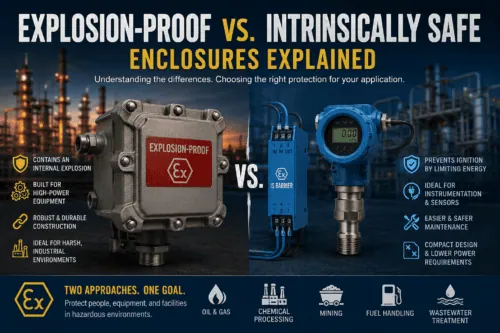
An explosion-proof enclosure is built with the assumption that an ignition may occur inside the enclosure itself. Rather than attempting to eliminate sparks or heat, the enclosure is engineered to contain an internal explosion and prevent flames from escaping into the surrounding atmosphere.
How Explosion-Proof Enclosures Work
These enclosures are typically manufactured from heavy-duty materials such as cast aluminum, stainless steel, or iron. Threaded joints, flame paths, reinforced covers, and tightly controlled tolerances help cool escaping gases before they can ignite the external environment.
This style of protection is commonly found in applications involving motors, junction boxes, disconnects, pumps, and high-power electrical equipment. Refineries, compressor stations, grain facilities, and paint processing operations frequently rely on explosion-proof designs because of the demanding operating conditions and higher electrical loads involved.
Installation and Maintenance Considerations
The physical construction of explosion-proof equipment often makes it noticeably larger and heavier than standard industrial enclosures. Installation usually involves specialized conduit sealing methods and strict adherence to hazardous-location wiring requirements.
Maintenance also requires attention to detail because damaged threads, improperly secured covers, or altered flame paths can compromise the enclosure’s protective capabilities. Technicians servicing explosion-proof equipment must ensure all components remain compliant with the enclosure’s original certification standards.
What Is an Intrinsically Safe System?
Intrinsically safe systems approach the problem from a completely different direction. Instead of containing an explosion, intrinsic safety focuses on preventing ignition from occurring in the first place.
The system is designed to limit electrical and thermal energy to levels below what would be required to ignite a hazardous atmosphere, even under fault conditions.
How Intrinsic Safety Works
This protection method is especially common in instrumentation and process control applications. Flow meters, pressure transmitters, temperature sensors, tank monitoring equipment, and analytical devices are often designed as intrinsically safe systems because they operate with relatively low power requirements.
Energy-limiting barriers and galvanic isolators play a central role in intrinsic safety design. These components restrict the amount of voltage and current that can travel into hazardous areas. Since the energy available is intentionally kept below ignition thresholds, the likelihood of sparks or excessive surface temperatures creating combustion hazards is dramatically reduced.
Benefits of Intrinsically Safe Designs
The operational advantages of intrinsic safety become especially noticeable during maintenance and troubleshooting. Technicians can often work on intrinsically safe instrumentation without fully shutting down the hazardous process area, which helps reduce downtime and simplify service procedures.
The wiring methods are frequently less cumbersome than explosion-proof conduit systems, and the overall equipment footprint is usually smaller. These characteristics make intrinsic safety especially attractive for facilities with extensive instrumentation networks.
Practical Limitations
Power limitations create practical boundaries for intrinsically safe systems. High-power devices such as motors, heaters, or large electrical assemblies generally cannot operate within intrinsic safety energy restrictions.
That limitation is one reason explosion-proof protection remains heavily used throughout industrial facilities.
Choosing Between Explosion-Proof and Intrinsically Safe Protection
The decision between explosion-proof and intrinsically safe protection is rarely based on a single factor. Hazardous-area classification plays a major role, but operating conditions, maintenance requirements, environmental exposure, equipment size, and long-term operating costs all influence the selection process.
Applications Favoring Explosion-Proof Equipment
Facilities operating large mechanical equipment in rugged outdoor environments often lean toward explosion-proof housings because they provide robust physical protection alongside hazardous-area compliance.
Applications involving high-power electrical systems or harsh industrial conditions may benefit from the durability and containment capabilities of explosion-proof enclosures.
Applications Favoring Intrinsic Safety
Applications involving process instrumentation, monitoring systems, and flow measurement devices frequently favor intrinsic safety because of the reduced maintenance burden and easier field servicing.
Facilities looking to simplify troubleshooting procedures or minimize operational downtime may find intrinsically safe systems more practical for day-to-day operations.
Flow Measurement Equipment in Hazardous Areas
Flow measurement systems offer a useful example of how these protection philosophies are applied in real industrial environments. Turbine flow meters, pressure transmitters, batching systems, and flow monitoring assemblies are commonly installed in hazardous locations where flammable liquids or gases are present.
Depending on the process requirements, a manufacturer may supply intrinsically safe transmitters for low-power signal applications or explosion-proof electronics housings for installations requiring greater electrical capacity or environmental durability.
The correct choice often depends on the surrounding hazardous classification, available power, environmental exposure, and maintenance accessibility.
Certifications and Compliance Requirements
Compliance with hazardous-location standards remains essential regardless of which protection strategy is selected. Regulations and certifications such as NEC, ATEX, IECEx, UL, and CSA establish the requirements for equipment construction, installation practices, and system approvals.
Improperly mixing components, altering certified equipment, or using incorrect wiring methods can create serious safety risks and regulatory violations.
Selecting hazardous-area equipment should involve more than simply matching a classification label. Maintenance accessibility, environmental conditions, operating voltage, process media, and future serviceability all deserve careful consideration during system design.
A protection method that performs well in one facility may create unnecessary complexity in another.
So Does Explosion Proof Or Intrinsically Safe Work Best For You?
Explosion-proof and intrinsically safe systems both serve critical roles throughout industrial operations. One contains ignition events inside a reinforced enclosure. The other works to ensure ignition never occurs at all.
Understanding how each method functions helps engineers, operators, and maintenance teams choose equipment that supports both safety and long-term operational reliability.