Clean-in-place, or CIP, systems are an essential part of modern food and beverage processing. They allow processors to clean tanks, piping, valves, heat exchangers, and other equipment without completely disassembling the process line.
A properly designed CIP system helps improve sanitation, reduce downtime, support repeatable cleaning procedures, and limit unnecessary water and chemical use. But for a CIP cycle to perform consistently, operators need more than pumps, tanks, and cleaning chemicals. They also need reliable process measurement.
Flow measurement plays an important role in verifying that cleaning fluids move through the system at the proper rate during each stage of the CIP process. If flow is too low, cleaning effectiveness may suffer. If it is too high, the system can waste water, chemicals, and energy or operate outside intended process conditions.
Understanding where and how flow meters fit into CIP systems can help food and beverage processors improve cleaning consistency, automation, and overall process visibility.
What Is a CIP System in Food & Beverage Processing?
A CIP system is designed to clean the internal surfaces of process equipment without requiring major disassembly.
Instead of manually removing piping, valves, or tanks for cleaning, the system circulates cleaning solutions through the same equipment used during production.
How Clean-in-Place Systems Work
Although every installation is different, many CIP systems use several cleaning stages.
Pre-Rinse
The initial rinse removes loose product residue and prepares the system for chemical cleaning.
Water is typically circulated through the process line before detergent or caustic solutions are introduced.
Caustic or Detergent Wash
A cleaning solution is circulated through the system to remove fats, proteins, sugars, oils, and other residues left behind during production.
Maintaining the appropriate temperature, concentration, contact time, and flow conditions is important during this stage.
Intermediate Rinse
Water may be circulated between chemical cleaning stages to remove residual detergent or caustic solution.
Acid Wash or Sanitizing Cycle
Depending on the application, an acid wash or sanitizing stage may be used to remove mineral deposits or reduce microbial contamination.
Final Rinse
A final rinse helps remove remaining cleaning chemicals before the process line is returned to production.
Why CIP Is Important in Sanitary Processing
CIP systems help processors maintain consistent cleaning procedures while reducing manual intervention.
Product Safety
Effective cleaning helps remove residues that can support microbial growth or contaminate future production batches.
Cross-Contamination Prevention
Cleaning between products can help reduce the risk of ingredients, flavors, allergens, or other materials carrying over from one production run to another.
Consistent Cleaning Results
Automated CIP systems can repeat the same cleaning sequence with greater consistency than fully manual procedures.
Where Flow Measurement Fits Into a CIP System
Flow is one of the primary variables used to understand whether cleaning fluid is moving through the system as intended.
Verifying Cleaning Solution Flow Rate
A flow meter can verify that cleaning solutions are circulating at the required rate.
If the pump is running but the actual flow rate is lower than expected, a restriction, valve problem, pump issue, or other system condition may be affecting the cleaning cycle.
Confirming Adequate Velocity Through Process Lines
CIP systems often depend on sufficient fluid velocity to create the turbulence needed to remove residue from piping surfaces.
Because pipe diameter influences velocity, measuring flow can help operators confirm whether enough liquid is moving through the line to achieve the intended cleaning conditions.
Monitoring Rinse Water
Flow measurement can help confirm that the appropriate amount of rinse water is being used during pre-rinse, intermediate rinse, and final rinse stages.
This can also help facilities identify opportunities to reduce unnecessary water consumption.
Measuring Chemical and Detergent Addition
Some systems meter cleaning chemicals into the CIP circuit.
Flow data can support controlled dosing and help operators verify that the proper amount of cleaning solution is introduced.
Tracking CIP Return Flow
Flow measurement on the return side of the CIP system can provide additional information about circulation performance.
Differences between expected supply and return flow may help identify leaks, bypass conditions, restrictions, or other process issues.
Why Accurate Flow Measurement Matters During CIP
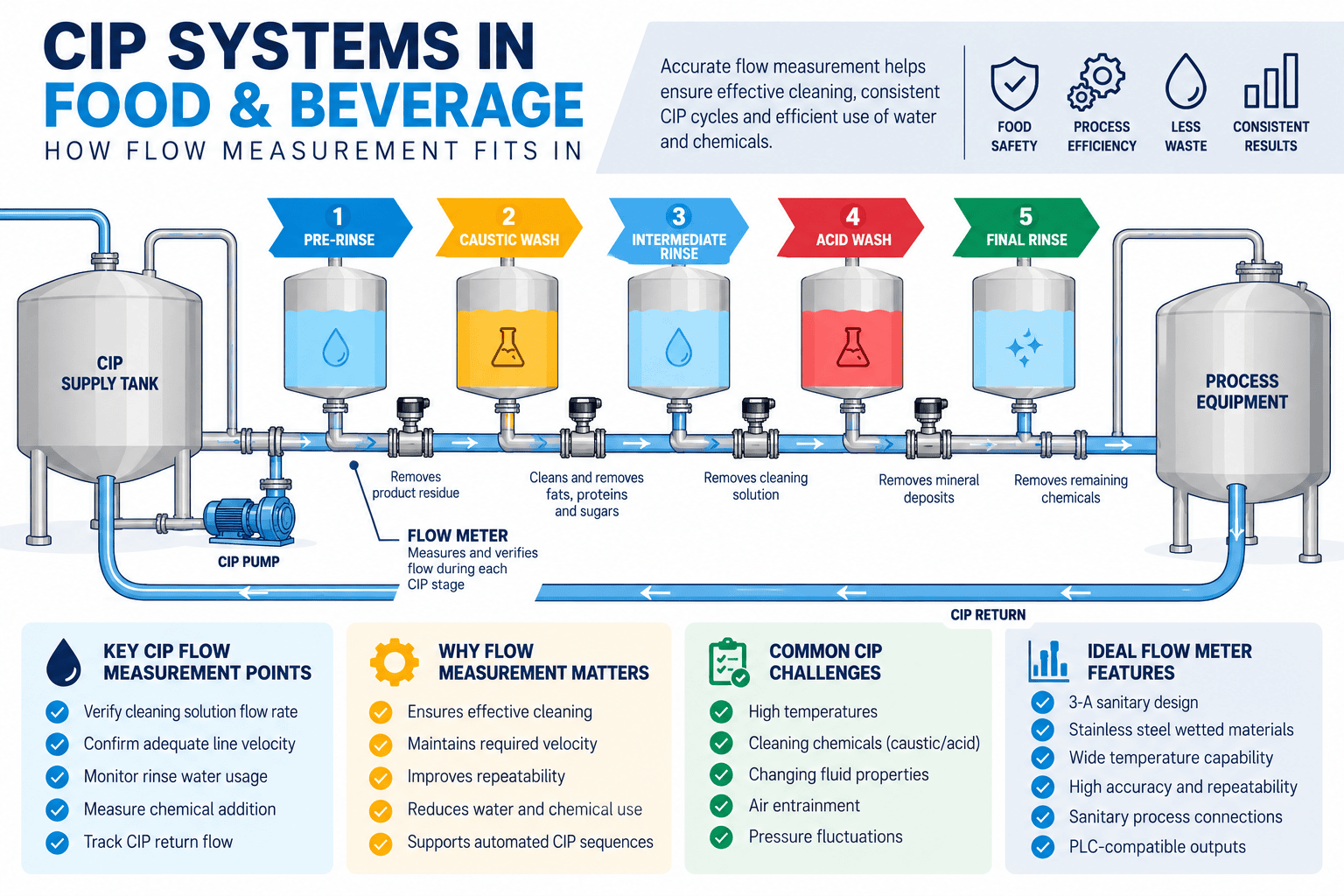
Flow measurement does more than confirm that liquid is moving through the pipe.
It can help determine whether the cleaning process is operating within the conditions established for effective cleaning.
Maintaining the Required Cleaning Velocity
Flow rate and pipe size directly influence fluid velocity.
What Happens When Flow Is Too Low
Insufficient flow may reduce turbulence inside the piping.
Without enough turbulence, cleaning solution may not effectively remove residue from internal surfaces.
Low flow can also indicate restrictions, partially closed valves, pump problems, or clogged components.
What Happens When Flow Is Too High
Excessive flow can increase pressure drop and energy use.
It can also increase pump demand and place unnecessary stress on process components.
The goal is not simply to maximize flow, but to maintain the flow conditions required by the cleaning process.
Improving Cleaning Repeatability
Using measured flow instead of relying only on pump speed or assumed performance can make CIP cycles more repeatable.
Operators can verify that similar flow conditions occur from one cleaning cycle to the next.
Reducing Water and Chemical Consumption
Monitoring flow allows processors to better understand how much water and cleaning solution are actually being used.
This information can help optimize rinse durations and chemical circulation cycles.
Supporting Automated CIP Sequences
Flow signals can be integrated into a PLC or process control system.
The control system can use flow data to confirm that the system has reached the required operating condition before advancing to the next stage of the cleaning sequence.
Common Flow Measurement Challenges in CIP Applications
CIP systems create several measurement challenges that should be considered when selecting a flow meter.
Rapid Temperature Changes
Cleaning cycles may expose the flow meter to significant temperature changes as the system transitions between rinse water, heated cleaning solution, and production fluids.
The meter must be suitable for the expected operating temperature range.
Hot Water and Cleaning Chemicals
Flow meter materials must be compatible with the cleaning chemicals used in the system.
Wetted materials, bearings, seals, and process connections should all be evaluated for chemical and temperature compatibility.
Changing Fluid Properties
The fluid passing through the meter may change several times during a CIP cycle.
Water
Rinse water generally has relatively predictable flow characteristics.
Caustic Solutions
Cleaning solutions may have different densities and viscosities than water.
Acid Solutions
Acidic cleaning solutions may require additional material compatibility considerations.
Product Residue
During early rinse stages, the fluid may contain diluted product residue that changes its physical characteristics.
Air Entrapment and Two-Phase Flow
Air entering the process line can affect many flow measurement technologies.
Two-phase conditions involving both liquid and gas can produce unstable or inaccurate readings.
Proper piping design and system operation can help minimize entrained air.
Pressure Fluctuations
Valve sequencing and pump operation can produce pressure changes during CIP cycles.
The selected flow meter should have a pressure rating appropriate for both normal operating pressure and expected system transients.
Selecting a Flow Meter for a CIP System
Several application variables should be reviewed when selecting a flow meter for sanitary or CIP service.
Sanitary Construction
Food and beverage applications often require equipment specifically designed for hygienic processing.
3-A Sanitary Design
Depending on the process, sanitary equipment may need to meet industry-specific hygienic design requirements.
A sanitary flow meter should be designed to minimize areas where product or cleaning solution can become trapped.
Stainless Steel Wetted Materials
Stainless steel is commonly used in food and beverage process systems because of its durability, cleanability, and compatibility with many products and cleaning solutions.
Sanitary Process Connections
Connections should match the sanitary piping system used at the facility and allow the meter to be incorporated without creating unnecessary dead legs or difficult-to-clean areas.
Temperature Capability
The meter must be rated for the highest temperature it may experience during production and cleaning.
Required Flow Range
The expected minimum and maximum flow rates should remain within the meter’s operating range.
A meter that is oversized for the application may not provide the desired performance at low flow.
Accuracy and Repeatability
The required accuracy depends on how the measurement will be used.
For many CIP applications, repeatability can be especially valuable because operators want cleaning cycles to perform consistently from one run to the next.
Pressure Rating
The meter should be rated for the maximum operating pressure of the system, including potential pressure spikes.
Cleanability and Drainability
Sanitary installations should be designed so process fluids and cleaning solutions can drain effectively.
Meter orientation and piping layout can influence how well the system drains between cycles.
Turbine Flow Meters in CIP Applications
Turbine flow meters can be a good fit for many clean-liquid sanitary applications when operating conditions fall within the meter’s capabilities.
Where Turbine Flow Meters Work Well
Clean Liquids
Turbine meters perform well with clean, low- to moderate-viscosity liquids.
Rinse Water
Water measurement is a common application because of its predictable fluid characteristics.
Cleaning Solutions
Compatible caustic and cleaning solutions can also be measured when proper materials are selected.
Product Transfer Lines
A sanitary turbine flow meter may also serve the production process itself, allowing one meter to support both product transfer and CIP monitoring.
Benefits of Turbine Technology
Fast Response
Turbine meters respond quickly to changing flow conditions.
High Repeatability
Repeatable measurements can help processors monitor CIP consistency.
Compact Installation
Turbine meters can provide accurate measurement in a relatively compact inline design.
Pulse Output for Control Systems
The frequency output generated by many turbine meters makes it possible to transmit flow information to PLCs, displays, totalizers, and process controllers.
When Another Flow Technology May Be Better
No flow meter technology is ideal for every application.
Fluids With High Solids Content
Large amounts of suspended solids can affect moving components inside some turbine meters.
Highly Viscous Products
Viscosity changes can influence turbine meter performance and may require additional application review.
Applications With Entrained Air
Two-phase flow can create unstable measurements regardless of the flow meter technology being used.
CIP Flow Measurement in Common Food & Beverage Applications
CIP systems are used across many industries that require sanitary process equipment.
Dairy Processing
Milk, cream, yogurt, and other dairy products can leave proteins and fats inside process equipment.
Accurate flow measurement can help verify cleaning solution circulation during CIP cycles.
Breweries and Beverage Production
Breweries, soft drink facilities, wineries, and other beverage plants use CIP systems to clean tanks, transfer lines, fillers, and other equipment.
Food Ingredient Processing
Liquid sweeteners, oils, flavorings, concentrates, and other ingredients may require frequent cleaning between batches.
Pharmaceutical and Nutraceutical Processing
Sanitary process requirements can also apply to pharmaceutical and nutraceutical manufacturing where repeatable cleaning procedures are important.
Integrating Flow Measurement With CIP Controls
Modern CIP systems are often controlled through PLCs or distributed control systems.
Connecting Flow Meters to a PLC
A flow meter can send process data to a PLC using pulse, frequency, analog, or other supported outputs.
Using Pulse Signals for Totalization
Pulse signals can be used to calculate total fluid volume and verify how much rinse water or cleaning solution passes through the system.
Using Analog Outputs for Real-Time Flow Monitoring
A 4–20 mA or similar analog signal allows a control system to monitor flow continuously.
Setting Flow Alarms and Interlocks
Operators can establish minimum and maximum flow thresholds.
If the measured flow falls outside the acceptable range, the control system can generate an alarm or prevent the CIP cycle from advancing.
How Flow Data Can Improve CIP Efficiency
Once flow is measured consistently, the resulting data can provide useful insight into system performance.
Detecting Incomplete Cleaning Cycles
If required flow conditions are not reached, the system can flag the cycle for review.
Identifying Restricted or Blocked Lines
A gradual reduction in flow under similar pump conditions may indicate buildup or restriction in the process line.
Reducing Excess Water Usage
Flow data can help processors evaluate whether rinse stages are using more water than necessary.
Monitoring Changes in System Performance Over Time
Historical flow information can help maintenance teams identify changes in pumps, valves, piping, or other system components before they lead to larger operational problems.
Questions to Ask When Selecting a CIP Flow Meter
Before selecting a flow meter, engineers should understand the complete operating environment.
What Is the Minimum and Maximum Flow Rate?
The meter should cover the expected operating range during production and CIP.
What Temperatures Will the Meter Experience?
Include both product temperature and cleaning temperatures.
What Cleaning Chemicals Will Contact the Meter?
Material compatibility should be verified for every fluid that may pass through the meter.
What Pressure Is Expected During the CIP Cycle?
Consider normal operating pressure as well as possible pressure spikes.
What Sanitary Connection Is Required?
The flow meter should match the process piping and installation standards used by the facility.
What Output Signal Does the Control System Need?
Confirm whether the PLC or monitor requires pulse, frequency, analog, or another output.
Flow Measurement for Sanitary CIP Systems
Flow measurement can provide valuable visibility into how a CIP system performs during each cleaning stage.
Matching the Meter to the Process
The correct meter depends on fluid properties, temperature, pressure, flow range, sanitary requirements, and control system needs.
Balancing Accuracy, Cleanability and Pressure Drop
Measurement performance is only one consideration. Sanitary applications also require equipment that fits the overall process design and can be cleaned effectively.
Using Flow Measurement to Improve CIP Consistency
By monitoring rinse water, cleaning solutions, circulation flow, and return flow, food and beverage processors can gain better control over CIP operations.
Reliable flow measurement helps transform CIP from a timed cleaning sequence into a measurable process where operators can verify that required conditions are actually being achieved.
For facilities using sanitary turbine flow meters, proper meter selection and integration can provide accurate, repeatable flow information while supporting automated CIP controls and sanitary processing requirements.