Aerospace and rocket test stands require flow measurement systems that can perform under demanding operating conditions. High pressures, cryogenic temperatures, rapidly changing flow rates, and strict repeatability requirements can make selecting the right flow meter a critical part of test stand design.
Flow meters may be used to monitor fuels, oxidizers, hydraulic fluids, cooling liquids, compressed gases, and other process media throughout propulsion, component, and system testing. Choosing the correct meter depends on much more than pipe size alone. Before specifying a meter, consider flow range, pressure, temperature, fluid properties, accuracy, response time, and output requirements.
Why Flow Measurement Is Critical in Aerospace and Rocket Testing
Reliable flow data allows engineers to evaluate how a component or system performs under controlled test conditions. In propulsion testing, flow measurement can help quantify the amount of fuel or oxidizer supplied to an engine. In hydraulic testing, it can be used to evaluate pumps, actuators, valves, and other components.
Repeatability is especially important when comparing multiple test runs. Engineers need confidence that changes in measured performance are coming from the device under test rather than inconsistent instrumentation.
Monitoring Fuel, Oxidizer, Coolant, and Hydraulic Flow
A single aerospace test facility may have several different flow measurement requirements. Applications can include rocket engine fuel systems, cryogenic oxidizer lines, hydraulic test stands, cooling circuits, turbopump testing, injector development, and jet engine test cells.
Each application can place different demands on the flow meter.
Common Fluids Used on Aerospace Test Stands
Test systems may handle a wide variety of liquids and gases, including:
- Liquid nitrogen and other cryogenic liquids
- Liquid oxygen and cryogenic oxidizers
- Jet fuel and hydrocarbon fuels
- Hydraulic oils
- Water and glycol cooling mixtures
- Lubricants
- Compressed air and process gases
Fluid properties are important because density and viscosity can affect meter sizing and performance. The flow meter should be evaluated using the actual process conditions whenever possible.
How to Select a Flow Meter for an Aerospace Test Stand
Flow meter selection should begin with the application’s operating requirements rather than simply matching the meter to the piping diameter.
Determine the Minimum and Maximum Flow Rate
The expected flow range is one of the most important pieces of information when sizing a meter. An oversized meter may operate below its ideal measuring range during low-flow testing.
If the test stand has a large turndown requirement, the minimum flow condition should be considered just as carefully as maximum flow.
Consider Pressure and Temperature
Aerospace systems frequently operate at pressures and temperatures outside the ranges encountered in standard industrial applications.
High-pressure hydraulic, fuel, and propulsion systems may operate at several thousand PSI. Certain turbine flow meter configurations are available for applications reaching pressures as high as 15,000 PSI.
Temperature is equally important. Cryogenic test systems may operate hundreds of degrees below zero, while engine and thermal testing can expose instrumentation to elevated temperatures.
Determine Accuracy and Repeatability Requirements
Not every test stand requires the same level of accuracy.
Some applications prioritize precise absolute flow measurement, while others place greater emphasis on repeatability between test cycles. Understanding the purpose of the measurement helps determine the appropriate meter and calibration requirements.
Flow Measurement for High-Pressure Test Systems
High-pressure flow measurement requires instrumentation designed specifically for the mechanical stresses involved.
The meter’s pressure rating should exceed the application’s maximum expected pressure, including potential pressure spikes. Connections, meter body construction, seals, and associated instrumentation should also be appropriate for the system.
Pressure drop should be considered as well. An improperly sized meter can create unnecessary restriction in the test circuit and potentially influence system performance.
Flow Measurement for Cryogenic Rocket Testing
Cryogenic flow measurement presents additional challenges because extremely low temperatures can affect materials, electronics, bearings, and fluid behavior.
Preventing Flashing and Cavitation
One of the most important considerations is maintaining the fluid in a liquid state as it passes through the meter.
If pressure drops below the fluid’s vapor pressure, flashing or cavitation may occur. This creates two-phase flow, which can significantly affect the reliability of volumetric flow measurements.
Proper system pressure and meter sizing can help minimize these conditions.
Managing Cooldown
Cryogenic systems often require a cooldown period before stable liquid flow is established. During this period, warmer piping can cause the incoming cryogenic fluid to boil.
Engineers should consider how the test stand determines when stable liquid conditions have been achieved before relying on flow measurements for test data.
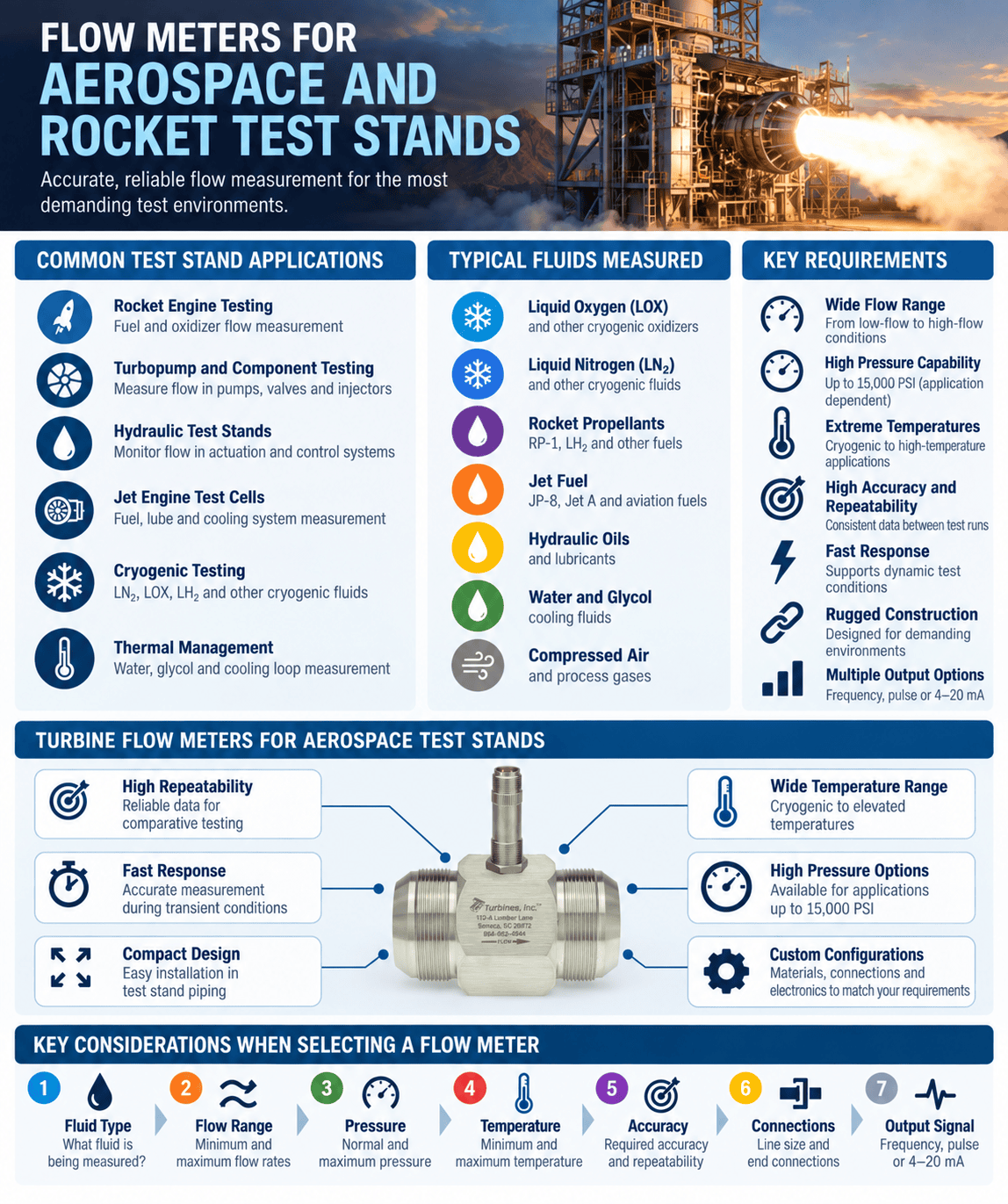
Turbine Flow Meters for Aerospace Test Stands
Turbine flow meters are commonly used in aerospace testing because they can provide fast response, high repeatability, and compact installation.
They are particularly well suited for clean, low-viscosity liquids such as fuels, cryogenic liquids, water, and certain hydraulic fluids.
As fluid moves through the meter, it rotates a turbine rotor. The rotational speed corresponds to flow velocity, producing a frequency signal that can be processed by a flow monitor, PLC, or data acquisition system.
This frequency-based output can be useful in aerospace test environments where high-speed data collection is required.
Connecting Flow Meters to Test Stand Data Acquisition Systems
Aerospace test stands often rely on centralized data acquisition systems to record multiple variables simultaneously.
Flow meters may provide:
Frequency or Pulse Output
Frequency output provides a direct relationship between turbine rotation and flow rate. A K-factor is typically used to convert pulses into engineering units.
4–20 mA Output
Signal conditioners and flow monitors can convert the raw meter signal into a standard 4–20 mA output for integration with PLCs and control systems.
Selecting the correct output depends on the test stand’s existing instrumentation and required sampling rate.
Calibration for Aerospace Flow Measurement
Calibration can be especially important when flow data is being used for performance analysis, component validation, or comparison between test runs.
Multi-point calibration can help characterize meter performance throughout its operating range. Calibration requirements should be discussed when the meter is specified, particularly for applications requiring high accuracy or traceability.
Questions to Answer Before Ordering a Flow Meter
Before selecting a flow meter for an aerospace or rocket test stand, engineers should determine:
- Fluid being measured
- Minimum and maximum flow rate
- Operating and maximum pressure
- Minimum and maximum temperature
- Fluid density and viscosity
- Required accuracy and repeatability
- Pipe or tubing size
- End connections
- Required output signal
- Calibration requirements
Providing this information allows the meter to be sized for the actual application rather than selected based solely on nominal line size.
Turbines, Inc. Flow Meters for Aerospace and Rocket Testing
Turbines, Inc. manufactures turbine flow meters for a wide range of demanding aerospace applications, including high-pressure, cryogenic, high-accuracy, low-flow, liquid, and gas measurement.
Meter configurations can be selected around the specific flow range, pressure, temperature, connection, and instrumentation requirements of the test stand.
For aerospace and propulsion applications, working with the flow meter manufacturer early in the design process can help ensure the meter is correctly sized and configured before the system reaches the test stage.