Chemical flushing often gets run by feel. Start the pump, circulate for a few hours, and hope the line comes out clean. When it doesn’t, the result is rework, wasted chemical, and a failed cleanliness check that delays startup.
The fix is to treat flushing as a flow-driven process. Cleaning happens because fluid moves through the system at the right velocity for the right amount of time, and the only way to know that is to measure it.
What Chemical Flushing Is and Where It’s Used
Chemical flushing circulates a cleaning fluid or solvent through a system to remove debris, oils, scale, and residues. It shows up in many places:
- Commissioning new piping and process systems
- Hydraulic and lube oil systems
- Heat exchangers and cooling loops, including glycol systems
- Product changeovers on process lines
- Chemical injection and dosing lines
- Fuel and solvent lines
In each case, a flush that falls short can lead to contamination, equipment wear, or off-spec product downstream.
Why Flow Rate Matters
Velocity drives cleaning. Turbulent flow scrubs contaminants off pipe walls and carries them out. Laminar flow tends to glide past them. Reynolds number is the practical measure here, and turbulent flow generally begins above a Reynolds number of roughly 4,000. Your fluid’s viscosity strongly affects whether you get there, which is why a cold, viscous cleaning fluid can behave very differently from the same system running warm.
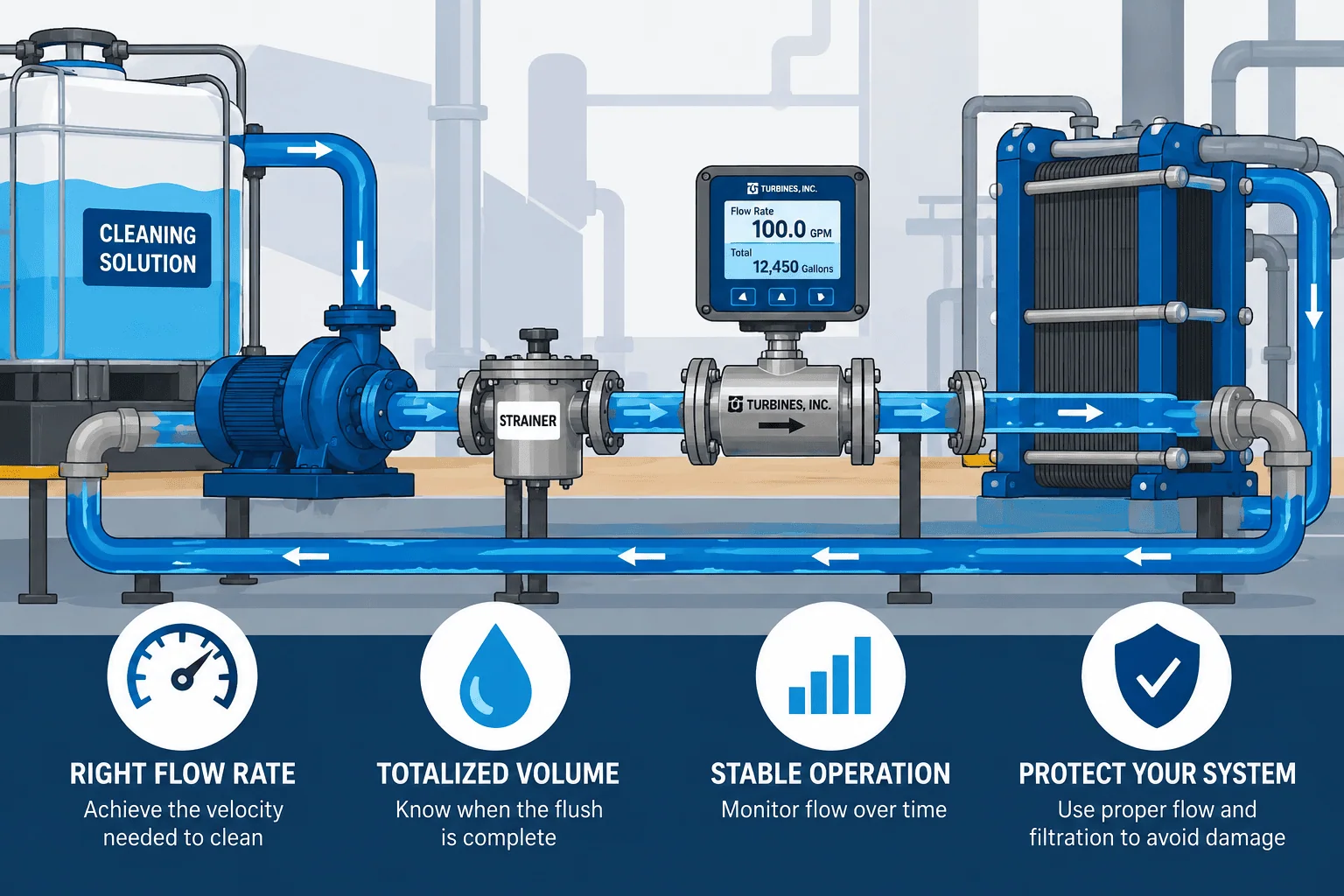
Volume and time tell you when you’re done. Flush procedures are often written in turnovers or total volume circulated. Without a totalized flow reading, you’re estimating from pump curves and run time.
More isn’t always better. Excessive flow can exceed pressure limits, strain pumps, and erode components. The goal is the target flow, not the maximum.
What Goes Wrong Without Measurement
Skipping measurement creates three common problems:
- Under-flushing. Contaminants stay in the system and show up later as fouled equipment or quality issues.
- Over-flushing. Extra hours of circulation burn through chemical, add disposal cost, and extend downtime.
- No proof. If a customer or QA team asks you to demonstrate that the flush met spec, “we ran it all day” isn’t documentation.
Relying on pump curves alone also misleads. Real-world flow depends on system resistance, fouling, and valve positions, and it changes as the flush progresses.
What to Measure
Four readings cover most flushing jobs:
- Instantaneous flow rate confirms you’re hitting your target velocity.
- Totalized volume tracks turnovers and chemical consumption.
- Flow stability over time helps you spot blockages, pump trouble, or system changes.
- Pressure drop across the system adds context. A climbing pressure drop at constant flow can point to fouling or restriction.
Chemistry and Meter Compatibility
Flushing fluids range from solvents and alcohols to mild acids, caustics, detergents, and glycol solutions. Because the meter is in contact with that fluid, wetted materials matter. Bearings, seals, and housings that perform well on clean water may not survive an aggressive cleaning chemical, so verify compatibility before you install anything.
Fluid properties also shift during a flush as temperature changes and the fluid picks up contaminants. Check that your meter’s viscosity range covers the full span of conditions, not just the starting point.
Choosing a Meter for Flushing
Start with these criteria:
- Flow range and turndown. Flush flow often differs from normal operating flow, so make sure the meter covers both.
- Fluid compatibility with the cleaning chemical.
- Viscosity range across the temperatures you’ll see.
- Line size and straight run available for installation.
- Accuracy required. Verifying a spec calls for more than a rough indication.
- Temporary or permanent installation.
Turbine meters are a strong fit for many flushing jobs. They handle a wide range of clean fluids, offer good repeatability, and are compact and cost-effective.
They do have a limit worth respecting: heavy particulate can damage a turbine meter. If the flush fluid will carry debris, a strainer or filter upstream is essential, and in very dirty services you may want to keep the meter out of the loop until the worst has been removed.
Installation Tips
- Install a strainer upstream to protect the meter from debris.
- Allow adequate straight run or use flow conditioning so readings are stable.
- Keep the line full. Air bubbles skew readings, so mount the meter where it stays flooded.
- Consider a bypass or spool piece so the meter isn’t exposed to the dirtiest part of the flush.
- Add a display, totalizer, or batch controller so the job runs hands-off and you capture the numbers you need.
Example: Flushing a 2-Inch Process Line
Say you need to flush a 2-inch Schedule 40 line (about 2.07 inches inside diameter). At roughly 100 GPM, the fluid moves at about 9.5 feet per second, which is well into turbulent territory for most low-viscosity cleaning fluids. A meter sized to cover that flow, with a strainer upstream and a totalizer on the display, lets you hold the target rate, log the circulated volume, and document the result when you’re done. Check your own spec for the required velocity, since targets vary by industry and system.
Checklist Before You Start
- Target flow rate and velocity defined
- Fluid and wetted material compatibility verified
- Meter sized for the flush flow range
- Strainer in place upstream
- Totalizer reset and a logging method decided
- Acceptance criteria agreed with all parties
Get the Right Meter for Your Flush
A flush is only as good as the flow behind it. If you’re not sure which meter fits your fluid, line size, and flow range, send us the details and our team will recommend a model. You can also use our sizing and pressure drop calculators to check your numbers before you buy.