Unexpected equipment failures are an unfortunate reality in industrial operations. While many facilities invest heavily in preventive maintenance programs, one area that is often overlooked is spare parts inventory for critical flow measurement equipment. A flow meter may represent only a small portion of a process system, but when it fails, the consequences can be significant. Production delays, inaccurate measurement, lost product, and costly emergency shipments can quickly outweigh the cost of maintaining a well-planned inventory of replacement components.
For facilities that rely on turbine flow meters and other precision flow measurement devices, having the right spare parts available can mean the difference between a repair that takes a few hours and a shutdown that lasts several days or even weeks. Long lead times, specialized components, and the critical role flow meters play in process control make spare parts planning an essential part of any maintenance strategy.
Why Spare Parts Inventory Matters
Flow meters are often viewed as highly reliable instruments, and in many applications they can operate for years with minimal maintenance. However, like any mechanical device, components eventually wear over time. Bearings degrade, seals age, electronics fail, and rotating assemblies can become damaged due to contamination or process conditions.
The challenge is that flow meter failures rarely occur at convenient times. A failed meter during a planned shutdown may be relatively easy to address. A failure during peak production, however, can create significant operational and financial consequences.
Maintaining a spare parts inventory provides several important benefits:
- Reduced unplanned downtime
- Faster repairs and maintenance response
- Lower emergency shipping costs
- Improved measurement reliability
- Reduced risk of production interruptions
- Greater flexibility during scheduled maintenance
Many facilities discover too late that replacement components are not readily available on-site. Depending on the flow meter manufacturer, model, and configuration, replacement parts may require expedited shipping or extended lead times. In critical applications, waiting for parts is often far more expensive than maintaining a modest spare parts inventory.
A proactive spare parts strategy helps ensure that repairs can be completed quickly while reducing maintenance costs and minimizing disruptions to production.
Bearings: The Most Important Turbine Flow Meter Spare Part
For turbine flow meters, bearings are typically the first component maintenance personnel should consider stocking. Bearings support the rotating turbine rotor and play a critical role in maintaining measurement accuracy.
Although modern turbine meter bearings are designed for long service life, they are still subject to wear from continuous operation. Process fluid characteristics, contamination, operating temperatures, and flow rates all influence bearing longevity. Even in relatively clean applications, bearings eventually experience normal wear that can affect meter performance.
As bearings begin to wear, operators may notice reduced accuracy, unstable readings, poor repeatability, or changes in calibration performance. In severe cases, bearing degradation can prevent the rotor from rotating properly, resulting in complete measurement failure.
Because bearings are relatively inexpensive compared to the cost of downtime, maintaining replacement bearing sets is often one of the most cost-effective decisions a facility can make. Plants that utilize multiple turbine flow meters of similar size and design should strongly consider stocking multiple bearing kits to support routine maintenance and unexpected repairs.
Complete Internal Repair Kits Offer Faster Repairs
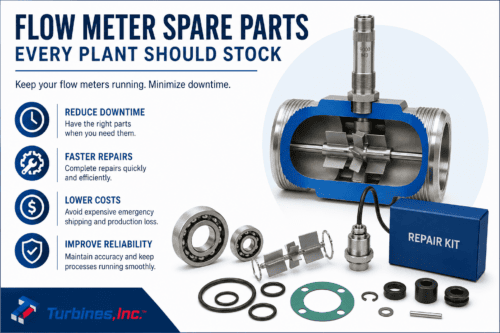
While individual components can often be replaced as needed, many facilities find value in stocking complete internal repair kits. These kits contain the most commonly serviced components required to rebuild the meter’s internal assembly without having to source parts individually.
A typical turbine flow meter internal repair kit may include:
- Bearings
- Rotor assembly
- Rotor shaft
- Bearing supports
- Retaining hardware
- O-rings and seals
- Other manufacturer-specific wear components
The primary advantage of a complete repair kit is simplicity. Rather than identifying individual failed components and ordering them separately, maintenance personnel can quickly rebuild the meter using a preconfigured set of manufacturer-approved parts.
Complete repair kits also reduce the risk of compatibility issues. Because all components are designed to work together, technicians can perform repairs with greater confidence that the meter will return to proper operating condition.
For facilities operating critical process lines where downtime is particularly costly, maintaining complete internal repair kits can significantly reduce repair times and improve maintenance efficiency.
Rotor Assemblies and Turbine Rotors
The rotor assembly serves as the heart of a turbine flow meter. As fluid passes through the meter, the rotor spins at a speed proportional to flow rate, allowing the instrument to generate an accurate measurement signal.
While rotor assemblies are designed for durability, they are not immune to damage. Foreign debris, excessive vibration, corrosion, cavitation, or mechanical shock can all contribute to rotor wear or failure.
Damaged rotors can create a variety of measurement issues, including erratic readings, reduced repeatability, poor calibration performance, and signal loss. In some situations, damage may not be immediately obvious, making troubleshooting more difficult.
Facilities operating in environments where contamination or harsh process conditions are present should consider maintaining replacement rotor assemblies for their most critical meters. Having a rotor assembly available can dramatically reduce downtime when internal damage is discovered during inspection or maintenance.
Pickup Coils and Sensors Should Not Be Overlooked
When maintenance teams think about flow meter spare parts, they often focus on mechanical components. However, electronic sensing devices are equally important and frequently overlooked.
In turbine flow meters, pickup coils or magnetic sensors detect rotor movement and generate the electrical signals used by control systems, PLCs, and flow computers. Without a functioning sensor, even a perfectly healthy turbine meter cannot provide useful measurement data.
Electronic failures can occur for numerous reasons. Moisture intrusion, electrical surges, vibration, aging components, and harsh environmental conditions can all affect sensor performance over time.
Symptoms of sensor failure may include:
- Intermittent pulse output
- Complete loss of signal
- Unstable flow readings
- Communication issues with control systems
- Inaccurate totalized flow measurements
Because these problems can appear suddenly, having replacement sensors readily available can significantly reduce troubleshooting and repair time.
Signal Conditioning Electronics and Pre-Amplifiers
Modern flow measurement systems often include electronic components beyond the primary sensor. Pre-amplifiers, signal conditioners, converters, and output modules help process and transmit flow data throughout the control system.
These components are particularly important in applications utilizing analog outputs, frequency outputs, remote monitoring systems, or advanced automation platforms.
Although these devices are generally reliable, electronic failures can occur unexpectedly. A failed signal conditioner may prevent accurate communication between the flow meter and the control system, creating operational issues even when the meter itself remains fully functional.
Because replacement electronic modules are often compact and relatively affordable, maintaining spares can provide substantial insurance against costly downtime.
O-Rings, Gaskets, and Sealing Components
Seals may seem insignificant compared to major flow meter components, but their importance should not be underestimated. O-rings, gaskets, and other sealing elements help maintain process integrity while preventing leaks and contamination.
Over time, seals can deteriorate due to temperature cycling, chemical exposure, pressure fluctuations, and normal aging. When seals fail, the result may be fluid leakage, environmental concerns, safety risks, or inaccurate measurement.
Because sealing components are inexpensive and easy to store, every facility should maintain an inventory of manufacturer-approved replacement seals for critical flow meters. Proper storage conditions are also important, as excessive heat, sunlight, and environmental exposure can shorten seal life before installation.
When It Makes Sense to Keep a Complete Spare Meter
In some applications, maintaining spare parts alone may not provide sufficient protection against downtime. Facilities operating custody transfer systems, LNG facilities, power generation equipment, remote installations, or other mission-critical processes may benefit from keeping an entire spare flow meter in inventory.
A complete spare meter allows maintenance personnel to quickly swap out a failed unit and return the process to operation while repairs are performed offline. This approach minimizes production interruptions and provides greater flexibility when calibration or extensive repairs are required.
Although purchasing a spare meter requires a larger upfront investment, many facilities find that the cost is easily justified when compared to the financial impact of prolonged downtime.
Building a Spare Parts Strategy That Supports Reliability
Every facility has different operational requirements, making it important to develop a spare parts strategy based on actual process needs.
When determining which spare parts to stock, consider:
- How critical the meter is to production
- Historical failure rates
- Manufacturer lead times
- Process safety requirements
- Number of identical meters in service
- Cost of downtime versus inventory cost
The most successful maintenance programs take a proactive approach. Rather than waiting for a component to fail, they identify critical flow measurement assets and ensure replacement parts are readily available before problems occur.
For turbine flow meters, this typically means maintaining an inventory that includes bearings, internal repair kits, rotor assemblies, pickup coils, electronic modules, and sealing components. Facilities with especially critical applications may also choose to keep complete spare meters available for immediate replacement.
The Cost of Downtime Is Higher Than the Cost of Spare Parts
When it comes to industrial operations, downtime is almost always more expensive than spare parts. A well-planned inventory of flow meter replacement components can help plants avoid costly production interruptions, maintain measurement accuracy, and extend the service life of critical equipment.
For most turbine flow meter applications, spare parts priorities should look something like this:
High Priority
- Bearing kits
- Pickup coils
- O-rings and seals
Medium Priority
- Rotor assemblies
- Complete internal repair kits
- Signal conditioning electronics
Critical Process Applications
- Complete spare meter assemblies
- Additional repair kits for high-use meters
- Backup electronics and display modules
By evaluating your flow measurement assets and identifying the components most likely to require service, you can create a maintenance strategy that keeps operations running smoothly while reducing the risk of unexpected failures.
For facilities that depend on turbine flow meters, investing in the right spare parts today can prevent costly downtime tomorrow. A relatively small investment in bearings, repair kits, sensors, and other critical components can save thousands—or even tens of thousands—of dollars in lost production when equipment issues arise. Ultimately, the goal is simple: have the parts you need before you need them.