Understanding the Risks, Warning Signs, and Prevention Methods in Industrial Applications
Cavitation is one of the most destructive hydraulic problems found in industrial flow systems. Although it often begins as a small pressure imbalance inside piping or equipment, the long-term effects can become severe. Pumps, valves, flow meters, and piping components exposed to repeated cavitation can suffer from erosion, vibration, unstable flow conditions, and premature failure.
In many industrial environments, cavitation develops gradually. Operators may initially notice inconsistent readings, unusual sounds, or increased vibration before realizing significant internal damage is already occurring. Left unresolved, cavitation can reduce process efficiency, compromise measurement accuracy, increase maintenance costs, and shorten the lifespan of critical equipment.
Industrial systems that operate under high velocities, fluctuating pressures, elevated temperatures, or demanding fluid conditions are especially vulnerable. Oil and gas systems, chemical processing facilities, cryogenic applications, aerospace fuel systems, and industrial manufacturing processes commonly encounter cavitation-related challenges because of the demanding operating conditions involved.
Understanding the root causes of cavitation is essential for engineers designing reliable flow systems and for operators responsible for maintaining long-term process stability.
What Is Cavitation?
Cavitation occurs when the pressure inside a flowing liquid drops below the fluid’s vapor pressure, causing portions of the liquid to vaporize and form small vapor bubbles within the flow stream. As the fluid continues through the system and pressure recovers, those bubbles collapse violently.
The collapse of these vapor cavities creates intense localized shockwaves that impact nearby surfaces at extremely high force. While the bubbles themselves are microscopic, the repeated implosions can gradually pit, erode, and weaken metal components throughout the system.
Unlike traditional boiling, cavitation does not require the entire fluid to reach its boiling temperature. Instead, localized low-pressure conditions create temporary vaporization even while the bulk fluid remains well below its normal boiling point. This distinction is important because many industrial systems experience pressure fluctuations capable of producing cavitation without obvious temperature-related warning signs.
In flow measurement systems, cavitation is particularly problematic because accurate measurement depends on stable and predictable fluid behavior. Once vapor bubbles form and collapse within the measurement area, flow instability increases and measurement performance can deteriorate rapidly.
How Cavitation Develops Inside Flow Systems
The formation of cavitation is closely tied to the relationship between pressure and velocity inside a fluid system. As fluid velocity increases, localized pressure often decreases. If that pressure falls below the liquid’s vapor pressure, vapor cavities begin to form.
These low-pressure regions commonly occur near:
- Pump impellers
- Control valves
- Pipe restrictions
- Sudden contractions
- High-velocity sections of piping
As the fluid exits the low-pressure area and pressure rises again, the vapor bubbles collapse almost instantly. The implosion generates intense energy concentrated against nearby surfaces.
Over time, repeated cavitation events create:
- Surface pitting
- Material erosion
- Increased vibration
- Noise generation
- Fatigue cracking
- Bearing wear
- Calibration instability
Even small amounts of cavitation occurring continuously can gradually damage expensive equipment.
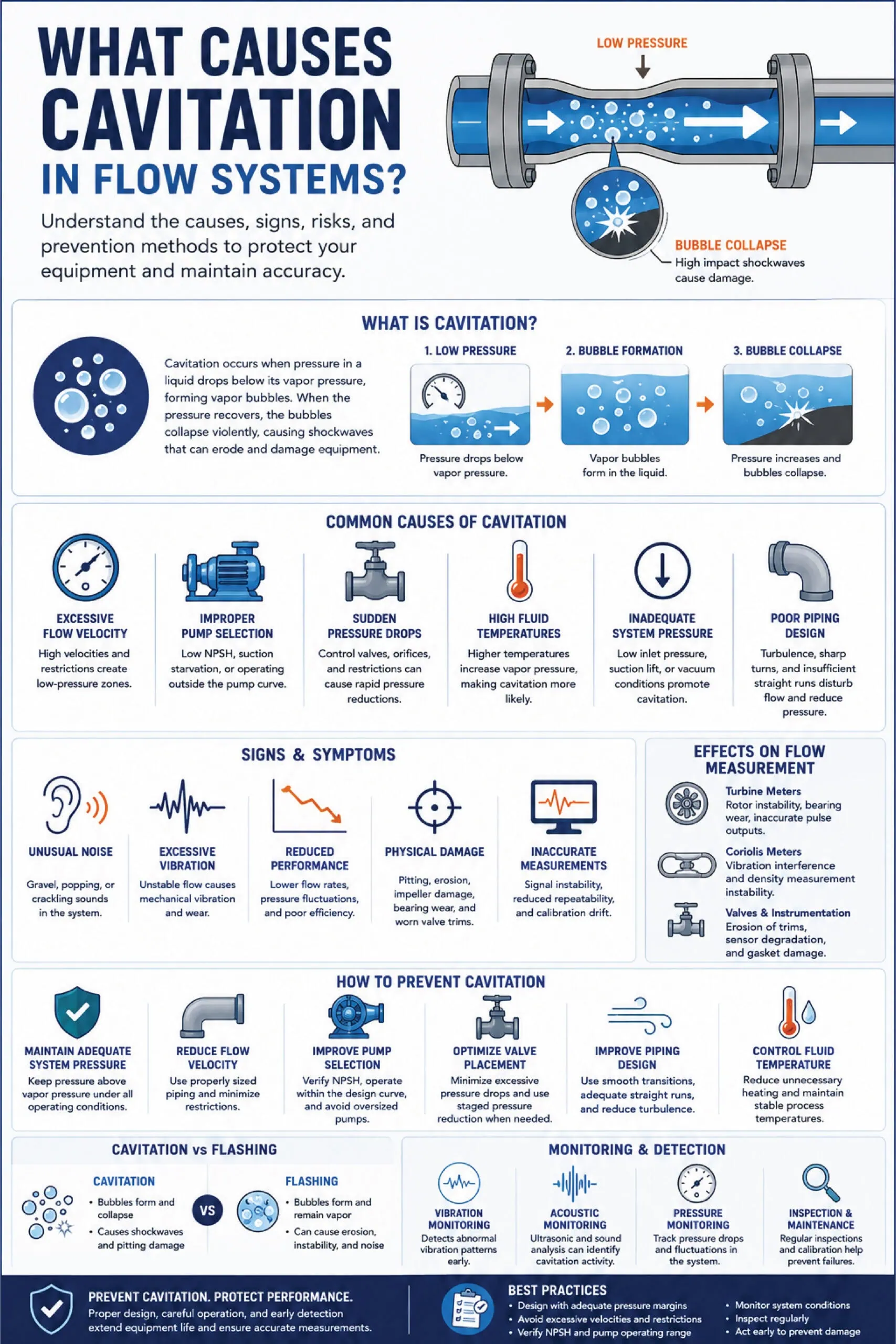
Common Causes of Cavitation
Cavitation rarely results from a single issue alone. In most industrial systems, it develops because multiple hydraulic and mechanical conditions combine to create unstable pressure environments.
Excessive Flow Velocity
One of the most common causes of cavitation is excessive fluid velocity. When liquids move too quickly through piping systems, pressure drops can occur rapidly, especially near restrictions or sudden directional changes.
High velocities are often caused by undersized piping, oversized pumps, or excessive flow demands within the system. Restrictions such as partially closed valves, sharp elbows, and abrupt pipe reductions further intensify localized pressure loss.
As pressure falls below vapor pressure, vapor cavities begin forming within the fluid stream.
Systems designed without adequate consideration for flow velocity are far more susceptible to cavitation damage over time.
Improper Pump Selection
Pump cavitation is one of the most common and costly forms of cavitation found in industrial systems. Pumps rely on adequate inlet pressure to maintain stable fluid movement through the impeller.
If suction pressure becomes too low, vapor bubbles form near the impeller blades. When those bubbles collapse inside higher-pressure regions of the pump, severe erosion and vibration can occur.
Common pump-related causes include:
- Incorrect NPSH calculations
- Low suction pressure
- Excessive suction lift
- Restricted inlet piping
- Operating outside the pump curve
- Oversized pumps operating inefficiently
Pump cavitation not only damages internal components but also reduces hydraulic efficiency and overall system performance.
Sudden Pressure Drops
Rapid pressure reductions across valves and restrictions frequently contribute to cavitation. Control valves are especially vulnerable because throttling creates localized pressure reductions immediately downstream of the valve trim.
In severe cases, bubble collapse occurs directly against valve surfaces, gradually eroding internal components and damaging valve seats.
Orifice plates, flow restrictions, partially closed valves, and sudden contractions can all create unstable pressure conditions that promote cavitation.
Elevated Fluid Temperatures
Temperature significantly influences vapor pressure. As fluid temperature increases, the vapor pressure of the liquid also rises. This means less pressure reduction is required for vaporization to occur.
Hot water systems, thermal transfer applications, and heated chemical processes are therefore more susceptible to cavitation than cooler systems operating under similar pressures.
Cryogenic systems present additional complexity because rapid temperature and pressure changes can create unstable phase transitions within the fluid.
Warning Signs of Cavitation
One of the challenges with cavitation is that internal damage often begins before operators recognize the warning signs. Early detection is critical because prolonged cavitation can permanently damage expensive flow equipment.
A common symptom is unusual noise coming from pumps, valves, or piping. Many operators describe the sound as gravel, marbles, or small stones moving through the system. Popping or crackling noises may also occur as vapor bubbles collapse.
Vibration is another major warning sign. Cavitation introduces unstable hydraulic forces into the system, creating excessive mechanical stress on pumps, bearings, valves, and instrumentation. Persistent vibration can eventually lead to fatigue cracking, loosened connections, and bearing failure.
Flow measurement instability is also common. Turbine flow meters exposed to cavitation may experience fluctuating rotor speeds, unstable pulse outputs, reduced repeatability, and long-term calibration drift. Other flow technologies can also experience signal instability as vapor cavities disrupt fluid consistency.
In advanced stages, physical damage becomes visible. Metal surfaces may show pitting, erosion, or irregular wear patterns caused by repeated bubble implosions.
Cavitation Prevention Methods
Preventing cavitation requires a system-wide engineering approach rather than focusing on individual components alone. Stable pressure management throughout the flow system is the key to minimizing cavitation risk.
Maintaining adequate system pressure is one of the most effective prevention strategies. Engineers must ensure pressure remains safely above the fluid’s vapor pressure under all operating conditions, including startup, shutdown, and peak demand scenarios.
Reducing excessive flow velocity also plays a major role. Larger pipe diameters, smoother flow paths, and properly sized valves help minimize unnecessary pressure drops throughout the system.
Pump selection is equally important. Proper NPSH calculations, stable suction conditions, and operating pumps within their intended performance range significantly reduce the likelihood of cavitation development.
Well-designed piping layouts also improve hydraulic stability. Smooth transitions, sufficient straight pipe runs, and reduced turbulence all help maintain more consistent pressure conditions within the system.
In high-temperature applications, temperature management may also be necessary to reduce vapor pressure and improve overall system stability.
Cavitation is a serious hydraulic phenomenon that can quietly damage industrial flow systems while reducing reliability, efficiency, and measurement accuracy. Although it often begins as a pressure-related issue, the resulting mechanical damage can affect nearly every component within a flow system.
Understanding how cavitation develops — and recognizing the conditions that contribute to it — allows engineers to design safer, more stable, and more reliable systems. Proper pressure management, pump selection, piping design, and flow control all play critical roles in cavitation prevention.
For industrial facilities relying on accurate flow measurement and long-term equipment performance, addressing cavitation early can significantly reduce maintenance costs, minimize downtime, and extend the lifespan of critical instrumentation and process equipment.